Is Chronic Inflammation Sneaking Up on You? Find out in just 60 seconds with this simple test


Autoimmune Clustering in Primary Biliary Cholangitis
A Hidden Case of Hashimotos
Author: Prem Nand, NZRD (Clinical Dietitian - Nutritionist) Published June 2026 Copyright: Maximised Nutrition Ltd
Introduction
When a person is diagnosed with one autoimmune disease, it is important to remember that autoimmune conditions often do not occur in isolation.
The immune system is governed by a complex interaction of genetic susceptibility, environmental triggers, infections, hormonal influences, and immune regulation. In some individuals, this creates a tendency for multiple autoimmune conditions to develop over time.
This phenomenon is known as autoimmune clustering.
One condition where this is particularly relevant is Primary Biliary Cholangitis (PBC), an autoimmune liver disease that frequently coexists with autoimmune thyroid disease, Sjörgren’s syndrome, celiac disease, and systemic sclerosis (Hirschfield et al., 2018; Lindor et al., 2019).
This article presents a case study of a woman with PBC whose severe fatigue and brain fog were initially attributed to her liver condition, but further testing revealed previously unrecognized Hashimoto's Thyroiditis.
What Is Primary Biliary Cholangitis?
Primary biliary cholangitis is a chronic autoimmune disease in which the immune system attacks the small bile ducts within the liver.
Over time, this can impair bile flow and contribute to:
• Fatigue
• Itching
• Dry eyes and dry mouth
• Digestive symptoms
• Nutritional deficiencies
• Progressive liver damage
Although the liver is the main organ affected, PBC is a systemic immune disorder rather than simply a liver condition (Lindor et al., 2019).
Autoimmune Diseases Commonly Cluster
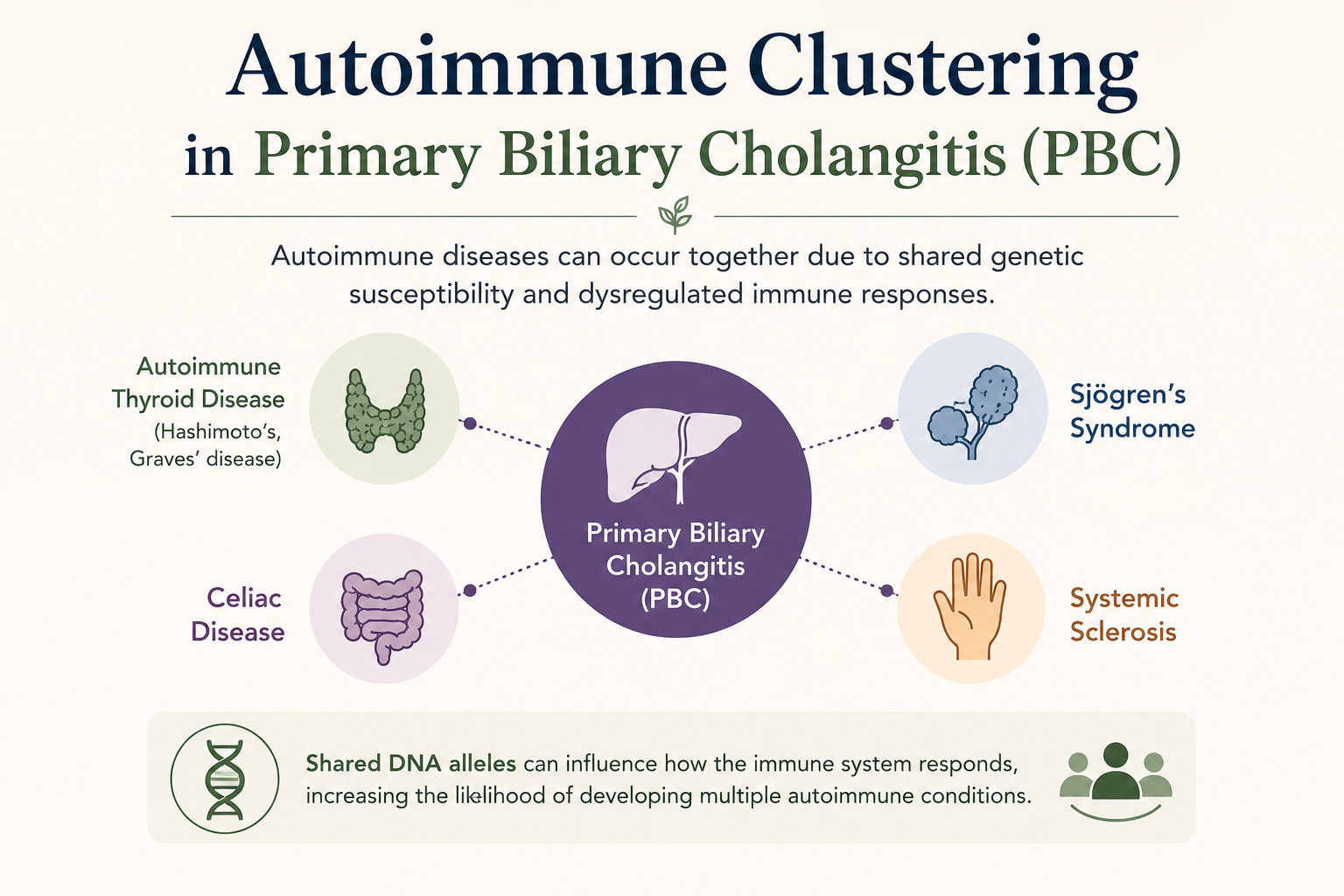
The immune system relies on genes involved in antigen presentation, immune tolerance, and inflammatory signalling. Variations in genes such as HLA alleles may increase the likelihood of multiple autoimmune diseases occurring in the same person (Gershwin et al., 2005).
In people with PBC, commonly associated autoimmune conditions include:
• Autoimmune thyroid disease (Hashimoto’s thyroiditis and Graves’ disease)
• Sjögren’s syndrome
• Celiac disease
• Systemic sclerosis
• Rheumatoid arthritis
This means that when new symptoms develop, clinicians should remain alert to the possibility of an additional autoimmune condition rather than assuming all symptoms are due to the original diagnosis.
Case Study: Severe Fatigue in a Patient With PBC
A woman in her 40s with confirmed PBC sought nutritional support because of:
• Severe fatigue
• Brain fog
• Poor concentration
• Constipation
• Weight gain
• Reduced ability to function in daily life
Initial laboratory findings included:
• Thyroid-stimulating hormone (TSH): 8.9 mIU/L
• C-reactive protein (CRP): 9 mg/L
Further thyroid testing showed:
• TSH: 8.5 mIU/L (elevated)
• Free T4: 17.2 pmol/L (normal)
• Free T3: 5.5 pmol/L (normal)
• Thyroid peroxidase (TPO) antibodies: 366 IU/mL (markedly elevated)
• CRP: 21 mg/L (elevated)
These findings were highly suggestive of Hashimoto’s thyroiditis with subclinical hypothyroidism.
Why Hashimoto’s Can Be Missed
Hashimoto’s thyroiditis is an autoimmune disease in which the immune system attacks the thyroid gland (Caturegli et al., 2014).
In early stages:
1. The thyroid is damaged.
2. The pituitary gland releases more TSH.
3. The thyroid works harder to maintain hormone production.
4. Free T4 and Free T3 may remain normal.
5. Symptoms still occur.
As a result, patients may be told their thyroid is “normal” despite significant clinical symptoms.
Understanding the Importance of TSH
TSH can be thought of as the body’s signal to the thyroid.
An elevated TSH means the pituitary gland is pushing the thyroid harder than usual to maintain normal hormone output.
A helpful analogy is:
• TSH = accelerator pedal
• T4 and T3 = engine speed
The engine may still be running at a normal speed, but only because the accelerator is pressed much harder than normal.
Common Symptoms of Hashimoto’s Thyroiditis
Even when Free T3 and Free T4 remain within the laboratory range, symptoms may include:
• Fatigue
• Brain fog
• Constipation
• Hair loss
• Weight gain
• Low mood
• Cold intolerance
• Heavy menstrual periods
In this case, these symptoms were severe enough to interfere with work and daily function.
Why the Diagnosis Matters
It can be tempting to attribute fatigue and cognitive difficulties solely to PBC.
However, identifying Hashimoto’s thyroiditis is important because it offers a potentially treatable contributor to symptoms.
A trial of Levothyroxine may be considered by the treating physician when:
• TSH is persistently elevated
• TPO antibodies are positive
• Symptoms are significant
• Another autoimmune condition is present (Jonklaas et al., 2014)
For some patients, treatment may improve energy, concentration, bowel function, and overall quality of life.
The Role of Inflammation
C-reactive protein rose from 9 mg/L to 17 mg/L, indicating ongoing systemic inflammation.
Inflammation may be driven by:
• Autoimmune activity
• Obesity
• Infection
• Digestive dysfunction
• Metabolic stress
Persistent inflammation can amplify fatigue and worsen symptom burden.
Clinical Lessons From This Case
This case highlights several important principles:
1. Primary biliary cholangitis is a systemic autoimmune disease.
2. Autoimmune diseases commonly cluster together.
3. Normal thyroid hormone levels do not exclude Hashimoto’s thyroiditis.
4. Elevated TPO antibodies are a strong marker of autoimmune thyroid disease.
5. Severe fatigue may have multiple treatable contributors.
When to Consider Additional Testing
If you have PBC and experience:
• Persistent fatigue
• Brain fog
• Constipation
• Weight gain
• Hair loss
• Cold intolerance
it may be worthwhile discussing a comprehensive thyroid assessment with your doctor, including:
• TSH
• Free T4
• Free T3
• Thyroid peroxidase antibodies (TPO antibodies)
Beyond the Liver
Primary biliary cholangitis affects more than the liver.
Because autoimmune conditions frequently coexist, symptoms such as fatigue and cognitive dysfunction should not automatically be attributed to PBC alone.
Looking for associated autoimmune diseases can uncover hidden contributors to poor health and create new opportunities for treatment and improved quality of life.
Conclusion
Autoimmune clustering is a well-recognized phenomenon in medicine.
In this case, a woman with primary biliary cholangitis was found to have previously unrecognized Hashimoto’s thyroiditis despite “normal” thyroid hormone levels.
Her elevated TSH, markedly positive TPO antibodies, and significant symptoms suggested that the thyroid was under substantial strain.
The lesson is simple but important: when one autoimmune disease is present, clinicians and patients should remain alert to the possibility of another.
Need a More Detailed Review of Your Blood Tests?
At Maximised Nutrition, we provide integrative clinical nutrition assessments for complex conditions involving autoimmune disease, thyroid dysfunction, gut health, and persistent fatigue.
References
Caturegli, P., De Remigis, A., & Rose, N. R. (2014). Hashimoto thyroiditis: Clinical and diagnostic criteria. Autoimmunity Reviews, 13(4–5), 391–397.
Gershwin, M. E., Selmi, C., Worman, H. J., et al. (2005). Risk factors and comorbidities in primary biliary cirrhosis: A controlled interview-based study. Hepatology, 42(5), 1194–1202.
Hirschfield, G. M., Dyson, J. K., Alexander, G. J. M., et al. (2018). The British Society of Gastroenterology and UK-PBC guidelines for the diagnosis and management of primary biliary cholangitis. Gut, 67(9), 1568–1594.
Jonklaas, J., Bianco, A. C., Bauer, A. J., et al. (2014). Guidelines for the treatment of hypothyroidism. Thyroid, 24(12), 1670–1751.
Lindor, K. D., Bowlus, C. L., Boyer, J., Levy, C., & Mayo, M. J. (2019). Primary biliary cholangitis: 2018 practice guidance from the American Association for the Study of Liver Diseases. Hepatology, 69(1), 394–419.

About the Author
Prem Nand, NZRD, is an Integrative Clinical Dietitian–Nutritionist and founder of Maximised Nutrition
in New Zealand. She uses a whole-body, systems-based nutrition approach to support people with complex and medically layered health conditions, considering the interconnected role of the gut, brain, nervous system, hormones, metabolism, inflammation, and lifestyle factors in human health.

Holistic Nutrition For A Happy, Healthy, Confident You!
Quick Links
INFORMATION ON THIS WEBSITE IS FOR INFORMATIONAL PURPOSES ONLY.
PLEASE ALWAYS CONSULT A QUALIFIED HEALTH PRACTITIONER FOR A PERSONALISED ADVICE FOR YOUR HEALTH CONDITION
© 2025 MAXIMISED NUTRITION LTD. All Rights Reserved.