Is Chronic Inflammation Sneaking Up on You? Find out in just 60 seconds with this simple test


Low Ferritin despite infusion and supplementation
When Low Ferritin Needs Further Investigation
Author: Prem Nand, NZRD (Clinical Dietitian - Nutritionist) Published May 2026 Copyright: Maximised Nutrition Ltd
Introduction
If you have low ferritin despite iron infusion or blood transfusion, it may be a sign that the underlying cause of your iron deficiency has not yet been identified.
Many people feel better after iron tablets, iron infusions, or even a blood transfusion. However, if ferritin continues to fall again over time, it is important to ask a deeper question: Why is the body losing iron or failing to absorb it properly?
In this article, we explore the hidden causes of low ferritin despite iron infusion or blood transfusion, using a real clinical case study.
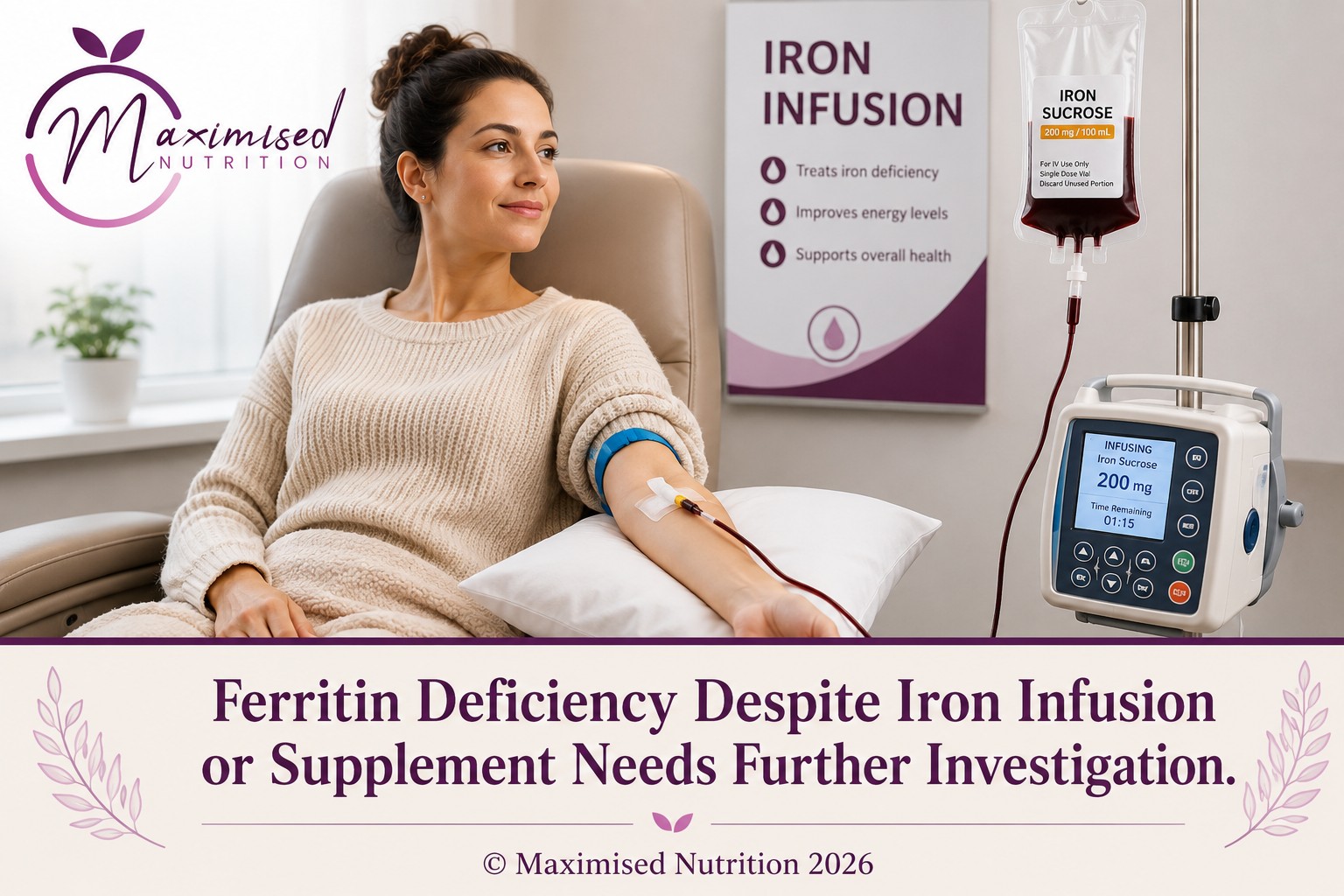
AI Generated Image: Does not represent real live person
A Real Case of Low Ferritin Despite Iron Infusion or Blood Transfusion
A woman in her mid-40s had a 16-year history of recurrent low ferritin.
Her ferritin results were as follows:
• 2010: 9 µg/L
• 2011: Increased to 104 µg/L after iron supplementation
• 2019: Fell to 21 µg/L
• 2024: Dropped to 13 µg/L
• January 2025: Increased to 182 µg/L after blood transfusion
• April 2026: Declined again to 57 µg/L
She also had:
• Confirmed Celiac disease
• Alternating constipation and diarrhoea
• Family history of Crohn's disease
• Fatigue and palpitations
• Normal vitamin B12 levels
This is a classic example of low ferritin despite iron infusion or blood transfusion, where treatment works temporarily but the root cause remains.
What Is Ferritin?
Ferritin is the protein that stores iron in your body. When ferritin is low, your iron reserves are depleted.
You can have symptoms of iron deficiency even when haemoglobin is still normal (Camaschella, 2015).
Common symptoms include:
• Fatigue
• Brain fog
• Hair loss
• Restless legs
• Palpitations
• Poor exercise tolerance
Why Does Ferritin Keep Falling?
When ferritin keeps dropping despite treatment, there are two main possibilities:
1. The body is losing iron
2. The body is not absorbing iron properly
Both must be considered when investigating low ferritin despite iron infusion or blood transfusion.
Heavy Menstrual Bleeding
In women, heavy periods are one of the most common causes of iron loss.
Even when menstrual bleeding seems “normal,” the total monthly blood loss can gradually deplete iron stores over time.
Coeliac Disease and Low Ferritin
Celiac disease damages the upper small intestine, where iron is primarily absorbed.
Despite a gluten-free diet, some people may still have:
• Ongoing intestinal inflammation
• Incomplete healing
• Accidental gluten exposure
Persistent iron deficiency is common in celiac disease (Rubio-Tapia et al., 2013).
Crohn’s Disease and Other Inflammatory Bowel Conditions
A family history of Crohn's disease increases the likelihood of inflammatory bowel disease.
Crohn’s disease can cause:
• Hidden blood loss
• Chronic inflammation
• Malabsorption
• Low ferritin
Microscopic colitis may also cause intermittent diarrhoea and is more common in people with autoimmune conditions.
Autoimmune Gastritis
Autoimmune gastritis is an often-overlooked cause of low ferritin despite iron infusion or blood transfusion.
In autoimmune gastritis, the immune system attacks stomach cells that produce:
• Hydrochloric acid
• Intrinsic factor
Low stomach acid reduces iron absorption, while intrinsic factor is needed for vitamin B12 absorption.
Can Vitamin B12 Still Be Normal?
Yes. Iron deficiency often appears years before vitamin B12 levels become abnormal (Hershko & Camaschella, 2014).
Helpful blood tests include:
• Parietal cell antibodies
• Intrinsic factor antibodies
H. pylori Infection
Helicobacter pylori infection can impair iron absorption by causing chronic gastritis and reducing stomach acid.
Studies show that treating H. pylori can improve ferritin levels (Muhsen & Cohen, 2008).
SIBO and Low Ferritin
Small Intestinal Bacterial Overgrowth can contribute to low ferritin despite iron infusion or blood transfusion.
Symptoms may include:
• Bloating
• Gas
• Alternating constipation and diarrhoea
• Food intolerance
• Nutrient deficiencies
Hydrogen–Methane Breath Testing can help assess for SIBO.
Blood Transfusion Does Not Fix the Root Cause
A blood transfusion replaces red blood cells and temporarily restores iron stores.
However, if the body continues to lose iron or cannot absorb it properly, ferritin will fall again.
This is like filling a bucket that still has a leak.
Recommended Investigations for Persistent Low Ferritin
Nutrition, Mental Health, and Functional Capacity
If you have low ferritin despite iron infusion or blood transfusion, consider discussing these investigations with your GP.
Blood Tests
• Full blood count
• Iron studies
• CRP and/or ESR
• Parietal cell antibodies
• Intrinsic factor antibodies
• Vitamin B12 and folate
Stool Tests
• Faecal calprotectin
• FIT (faecal occult blood test)
• H. pylori stool antigen
Procedures
• Colonoscopy
• Gastroscopy if indicated
Functional Testing
• Hydrogen–Methane Breath Test
Nutrition Strategies to Support Iron Levels
Medical investigation is essential, but nutrition also plays an important role.
Strategies may include:
• Strict gluten-free diet
• Iron-rich foods
• Vitamin C with meals
• Avoiding tea and coffee near meals
• Treating gut-related causes of malabsorption
When to Seek Professional Help
If your ferritin repeatedly falls despite treatment, do not assume you simply need more iron.
Persistent low ferritin may reflect:
• Coeliac disease
• Crohn’s disease
• Autoimmune gastritis
• H. pylori infection
• SIBO
• Microscopic colitis
• Heavy menstrual bleeding
Identifying the root cause is the key to long-term improvement.
Need Help With Low Ferritin Despite Iron Infusion or Blood Transfusion?
Conclusion
Trauma can influence multiple physiological systems, as well as behavioral and lifestyle patterns that affect overall health. These influences may extend to eating behaviors, digestion, energy levels, and the ability to maintain daily routines.
At Maximised Nutrition, I work with people experiencing complex gut, autoimmune, and nutrient-related conditions, including recurrent low ferritin.
A structured nutrition and gastrointestinal assessment can help identify possible contributors and support discussions with your GP or specialist.
References
Annibale, B., Capurso, G., Chistolini, A., D’Ambra, G., Di Giulio, E., Monarca, B., & Delle Fave, G. (2001). Gastrointestinal causes of refractory iron deficiency anemia in patients without gastrointestinal symptoms. The American Journal of Medicine, 111(6), 439–445.
Camaschella, C. (2015). Iron-deficiency anemia. The New England Journal of Medicine, 372(19), 1832–1843.
Hershko, C., & Camaschella, C. (2014). How I treat unexplained refractory iron deficiency anemia. Blood, 123(3), 326–333.
Mahadev, S., Laszkowska, M., Sundström, J., Björkholm, M., Lebwohl, B., Green, P. H. R., & Ludvigsson, J. F. (2017). Prevalence of celiac disease in patients with iron deficiency anemia: A systematic review. Gastroenterology, 152(4), 821–829.
Muhsen, K., & Cohen, D. (2008). Helicobacter pylori infection and iron stores: A systematic review and meta-analysis. Helicobacter, 13(5), 323–340.
Münch, A., Aust, D., Bohr, J., et al. (2012). Microscopic colitis: Current status, present and future challenges. Journal of Crohn's and Colitis, 6(9), 932–945.
Rubio-Tapia, A., Hill, I. D., Kelly, C. P., Calderwood, A. H., & Murray, J. A. (2013). ACG clinical guidelines: Diagnosis and management of celiac disease. The American Journal of Gastroenterology, 108(5), 656–676.
Torres, J., Mehandru, S., Colombel, J.-F., & Peyrin-Biroulet, L. (2017). Crohn’s disease. The Lancet, 389(10080), 1741–1755.

About the Author
Prem Nand, NZRD, is an Integrative Clinical Dietitian–Nutritionist and founder of Maximised Nutrition
in New Zealand. She uses a whole-body, systems-based nutrition approach to support people with complex and medically layered health conditions, considering the interconnected role of the gut, brain, nervous system, hormones, metabolism, inflammation, and lifestyle factors in human health.

Holistic Nutrition For A Happy, Healthy, Confident You!
Quick Links
INFORMATION ON THIS WEBSITE IS FOR INFORMATIONAL PURPOSES ONLY.
PLEASE ALWAYS CONSULT A QUALIFIED HEALTH PRACTITIONER FOR A PERSONALISED ADVICE FOR YOUR HEALTH CONDITION
© 2025 MAXIMISED NUTRITION LTD. All Rights Reserved.