Is Chronic Inflammation Sneaking Up on You? Find out in just 60 seconds with this simple test

Trauma Informed Nutrition Therapy
How Nutrition May Support Functional Capacity, Engagement, and Recovery.
Author: Prem Nand, NZRD (Clinical Dietitian - Nutritionist) Published May 2026 Copyright: Maximised Nutrition Ltd
Introduction
Trauma is increasingly recognized as a significant factor influencing long-term health and wellbeing. While much of the discussion has traditionally focused on psychological outcomes, there is growing evidence that trauma may also affect physiological systems, behavioral patterns, and day-to-day functioning (Felitti et al., 1998; McEwen, 2007).
In clinical practice, individuals with a history of trauma often present with complex and overlapping concerns. These may include fatigue, digestive symptoms, hormonal irregularities, mood fluctuations, and difficulty maintaining consistent routines. These patterns are rarely explained by a single diagnosis and often require a broader, integrative understanding of health.
Trauma-informed nutrition therapy is an emerging approach that considers how nutrition-related patterns may interact with physiological regulation, energy levels, and overall functional capacity. Rather than focusing solely on dietary intake, this approach explores how nutrition may support the body’s ability to engage in daily activities and therapeutic processes.
This perspective reflects the clinical work of Prem Nand, an Integrative Clinical Dietitian–Nutritionist, who applies a trauma-informed approach to nutritional care, particularly in complex cases where physiological patterns may influence functional capacity and engagement in recovery.
Understanding Trauma as a Whole-Body Experience
Trauma is not only a psychological experience—it also has measurable effects on biological systems. One of the most studied pathways is the hypothalamic–pituitary–adrenal (HPA) axis, which regulates the body’s stress response.
Chronic or repeated exposure to stress, particularly during early life, may alter HPA axis function, leading to changes in cortisol regulation and stress responsiveness (Charmandari et al., 2005; Heim & Nemeroff, 2001). Over time, this may contribute to what is described as allostatic load, referring to the cumulative physiological burden of chronic stress (McEwen, 2007).
In addition to the HPA axis, trauma may influence several interconnected systems, including:
• The hypothalamic–pituitary–ovarian (HPO) axis, affecting hormonal balance
• The autonomic nervous system, particularly the fight-or-flight response
• The immune system, potentially contributing to chronic inflammation
• The gut–brain axis, influencing digestion and gastrointestinal function
These interconnected systems highlight that trauma can affect the body in a systemic way, influencing both physical and mental health outcomes.
Adverse Childhood Experiences and Long-Term Health Outcomes
The relationship between early life experiences and long-term health has been well documented in the Adverse Childhood Experiences (ACEs) study. This research demonstrated strong associations between childhood trauma and a wide range of adult health conditions, including metabolic disease, cardiovascular disease, and mental health disorders (Felitti et al., 1998).
Further research has supported these findings, suggesting that early adversity may influence:
• Eating behaviors and dietary patterns
• Stress reactivity and emotional regulation
• Risk of chronic illness across the lifespan (Anda et al., 2006; Danese & McEwen, 2012)
It is important to note that these findings represent associations rather than direct causation. However, they provide valuable insight into how early life experiences may shape long-term health trajectories.
Stress, Appetite, and Eating Behaviour
Stress has a well-established impact on appetite and eating behavior. Activation of the stress response may influence food intake through hormonal and neurological pathways, particularly those related to reward and motivation (Adam & Epel, 2007).
In practice, this may present in different ways:
• Reduced appetite during periods of high stress
• Increased cravings for energy-dense or highly palatable foods
• Irregular eating patterns or skipped meals
• Emotional or stress-related eating
These responses are highly individual and may fluctuate over time. Importantly, they may influence not only nutritional intake but also energy levels, metabolic regulation, and overall wellbeing.
The Gut–Brain Axis and Digestive Function
The gut and brain are closely connected through a complex communication network known as the gut–brain axis. This system involves neural, hormonal, and immune pathways that influence both digestive and mental health (Mayer, 2011).
Stress and trauma may affect gut function through:
• Changes in gut motility (leading to constipation or diarrhoea)
• Increased gastrointestinal sensitivity
• Alterations in gut microbiota
These changes may contribute to symptoms such as bloating, abdominal discomfort, and irregular bowel habits. Even in the absence of structural disease, these symptoms can significantly impact daily functioning and quality of life.
Neurocognitive and Sensory Patterns in Trauma-Affected Clients
Some individuals with trauma histories may also present with neurocognitive or sensory differences that influence how they interact with food and daily routines.
These may include:
• Variability in attention and focus
• Sensory sensitivities (e.g., texture, smell, environment)
• Differences in routine and organization
• Fluctuating cognitive and physical energy
Emerging research suggests that trauma and neurodevelopmental differences may intersect in complex ways, although the exact relationships are still being explored (Kerns et al., 2015).
From a nutrition perspective, these patterns may influence:
• Food preferences and tolerances
• Meal consistency and timing
• Sensory responses to food
Recognizing these patterns allows for a more individualised and responsive approach to nutritional care.
Nutrition, Mental Health, and Functional Capacity
Nutrition plays a fundamental role in supporting physiological processes, including:
• Energy production
• Neurotransmitter synthesis
• Nervous system regulation
Inconsistent or inadequate nutritional intake may contribute to:
• Fatigue and low energy
• Brain fog and reduced concentration
• Mood variability
• Reduced resilience to stress
While nutrition is not a substitute for psychological therapy, it may influence an individual’s capacity to engage in therapeutic processes.
For example, reduced energy or cognitive clarity may make it more difficult to:
• Attend sessions consistently
• Process emotional material
• Retain and apply therapeutic insights
This highlights the importance of considering nutrition within a broader, multidisciplinary approach to care.
Functional Capacity and Engagement in Recovery
A central concept within trauma-informed nutrition therapy is functional capacity—the ability to carry out daily activities, maintain routines, and engage in care.
In practice, reduced functional capacity may present as:
• Low or fluctuating energy
• Irregular eating patterns
• Poor sleep quality
• Difficulty maintaining daily structure
• Reduced engagement in therapy
These factors are often interconnected. For example, irregular eating patterns may contribute to low energy, which in turn may reduce motivation and engagement in daily activities.
By focusing on functional capacity, clinicians can shift from a symptom-based approach to one that considers how individuals are functioning in their daily lives.
What Is Trauma-Informed Nutrition Therapy?
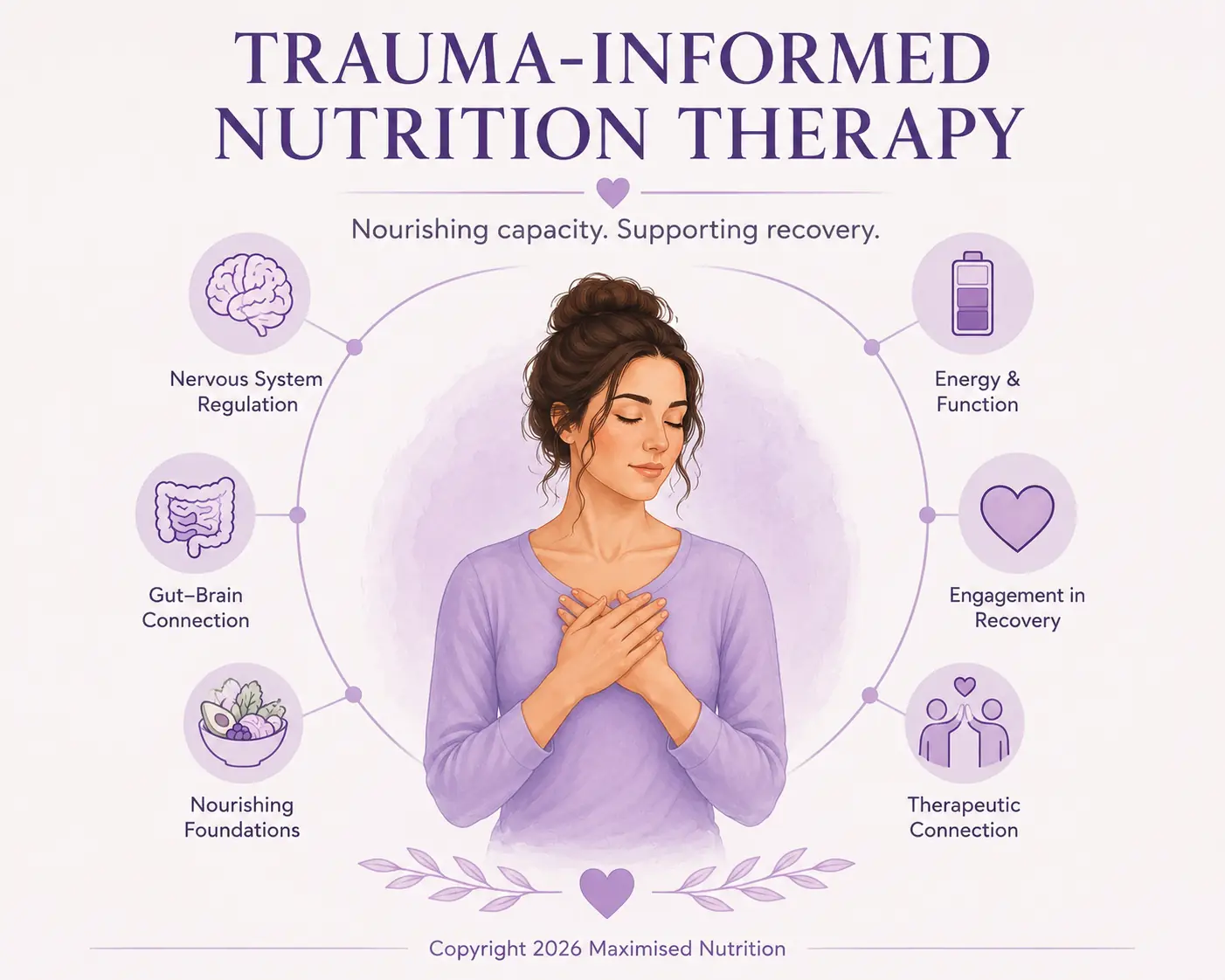
Trauma-informed nutrition therapy is an approach that integrates principles of trauma-informed care into nutritional practice. It recognizes that stress, past experiences, and physiological patterns may influence eating behaviors, nutritional intake, and overall health.
Key principles include:
• Supporting safety, consistency, and predictability
• Adapting recommendations to the individual’s capacity
• Avoiding overly restrictive or prescriptive approaches
• Working collaboratively within a multidisciplinary team
Rather than focusing solely on dietary change, this approach considers how nutrition may support stability, engagement, and overall functioning.
A Practical, Integrative Perspective
In clinical settings, trauma-informed nutrition therapy involves observing patterns over time rather than focusing on isolated symptoms.
This may include considering:
• Energy levels throughout the day
• Consistency of meals and routines
• Digestive comfort
• Sleep quality
• Engagement in daily activities
These observations can help identify areas where support may be beneficial, without requiring overly complex or restrictive interventions.
Importantly, this approach remains individualised and flexible, recognizing that each person’s experience and capacity are unique.
Conclusion
Trauma can influence multiple physiological systems, as well as behavioral and lifestyle patterns that affect overall health. These influences may extend to eating behaviors, digestion, energy levels, and the ability to maintain daily routines.
Trauma-informed nutrition therapy provides a framework for understanding these patterns within a broader context of health and recovery. By focusing on functional capacity and engagement, this approach supports individuals in a way that is both practical and person-centred.
Nutrition support may play a role in improving an individual’s ability to engage in and benefit from therapeutic processes, contributing to overall wellbeing and long-term recovery.
References
Adam, T. C., & Epel, E. S. (2007). Stress, eating and the reward system. Physiology & Behavior, 91(4), 449–458.
Anda, R. F., Felitti, V. J., Bremner, J. D., Walker, J. D., Whitfield, C., Perry, B. D., et al. (2006). The enduring effects of abuse and related adverse experiences in childhood. European Archives of Psychiatry and Clinical Neuroscience, 256(3), 174–186.
Charmandari, E., Tsigos, C., & Chrousos, G. (2005). Endocrinology of the stress response. Annual Review of Physiology, 67, 259–284.
Danese, A., & McEwen, B. S. (2012). Adverse childhood experiences and allostatic load. Physiology & Behavior, 106(1), 29–39.
Felitti, V. J., Anda, R. F., Nordenberg, D., Williamson, D. F., Spitz, A. M., Edwards, V., et al. (1998). Relationship of childhood abuse to adult disease. American Journal of Preventive Medicine, 14(4), 245–258.
Heim, C., & Nemeroff, C. B. (2001). Childhood trauma and neurobiology. Biological Psychiatry, 49(12), 1023–1039.
Kerns, C. M., Newschaffer, C. J., & Berkowitz, S. J. (2015). Trauma and autism. Journal of Autism and Developmental Disorders, 45(11), 3475–3486
Mayer, E. A. (2011). Gut–brain communication. Nature Reviews Neuroscience, 12(8), 453–466.
McEwen, B. S. (2007). Stress and adaptation. Physiological Reviews, 87(3), 873–904.

About the Author
Prem Nand, NZRD, is an Integrative Clinical Dietitian–Nutritionist and founder of Maximised Nutrition
in New Zealand. She uses a whole-body, systems-based nutrition approach to support people with complex and medically layered health conditions, considering the interconnected role of the gut, brain, nervous system, hormones, metabolism, inflammation, and lifestyle factors in human health.

Holistic Nutrition For A Happy, Healthy, Confident You!
INFORMATION ON THIS WEBSITE IS FOR INFORMATIONAL PURPOSES ONLY.
PLEASE ALWAYS CONSULT A QUALIFIED HEALTH PRACTITIONER FOR A PERSONALISED ADVICE FOR YOUR HEALTH CONDITION
© 2025 MAXIMISED NUTRITION LTD. All Rights Reserved.