Is Chronic Inflammation Sneaking Up on You? Find out in just 60 seconds with this simple test

Types of Laxatives in New Zealand
How Nutrition May Support Functional Capacity, Engagement, and Recovery.
Author: Prem Nand, NZRD (Clinical Dietitian - Nutritionist) Published May 2026 Copyright: Maximised Nutrition Ltd
Introduction
Constipation is a common digestive issue, and knowing the different types of laxatives in New Zealand can help you find effective relief. In New Zealand, it is often managed first through lifestyle and dietary modifications. However, when these are insufficient, laxatives may be required. This article outlines the various types of laxatives available in New Zealand, when they should be used, how long they should be taken, and the risks of prolonged use.
When to Consider Laxatives
Before starting laxatives, it is important to address modifiable risk factors:
– Low Fibre Intake: Fibre increases stool bulk and promotes motility. Increasing intake of fruits, vegetables, legumes, and whole grains can often relieve mild constipation (Healthify NZ, n.d.-a).
– Inadequate Fluid Intake: Proper hydration helps soften stools, making them easier to pass (bpacNZ, 2019).
– Lack of Physical Activity: Sedentary lifestyles contribute to slower bowel motility (HealthInfo Canterbury, n.d.).
Laxatives are generally considered when these measures have failed or if constipation is causing significant discomfort or risk.

Types of Laxatives and Their Use
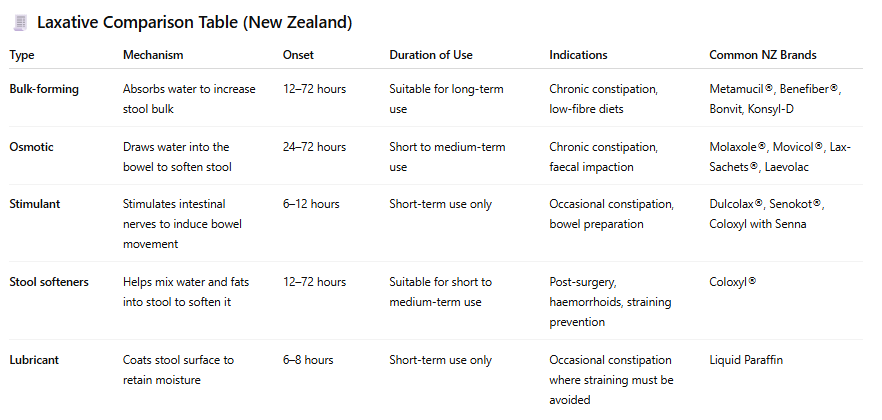
Laxatives are categorized by their mechanism of action. The following outlines each category, its indications, and examples commonly available in New Zealand.
1. Bulk-Forming Laxatives
Mechanism: These increase stool bulk by absorbing water, thereby stimulating peristalsis.
Onset: 12 to 72 hours.
Indications: Ideal for long-term constipation management, especially in individuals with low fibre intake (NHS, n.d.).
Common Brands: Metamucil®, Benefiber®
Considerations: Must be taken with sufficient fluid. May cause bloating and gas (Healthify NZ, n.d.-b).
2. Osmotic Laxatives
Mechanism: Draw water into the colon, softening stool and increasing pressure for bowel movement.
Onset: 24 to 72 hours.
Indications: Chronic constipation, especially in elderly and post-surgical patients (bpacNZ, 2019).
Common Brands: Movicol®, Duphalac®, Lax-Sachets®
Considerations: Can cause bloating. Requires hydration (Healthify NZ, n.d.-a).
Molaxole® is another example of an osmotic laxative widely used in New Zealand. It contains macrogol 3350 with electrolytes (sodium chloride, potassium chloride, and sodium bicarbonate). It works by drawing water into the colon to soften stools and stimulate bowel movements.
Indications: chronic constipation and faecal impaction (under medical supervision).
Available over-the-counter in sachet form.
Onset: 24–48 hours.
Important: Ensure adequate fluid intake during use to maintain hydration and electrolyte balance.
3. Stimulant Laxatives
Mechanism: Stimulate the enteric nerves to induce bowel contractions.
Onset: 6 to 12 hours.
Indications: Short-term use, opioid-induced constipation or bowel prep (Medsafe, 2021).
Common Brands: Senokot®, Dulcolax®
Considerations: Not for long-term use due to risk of dependency and cathartic colon (Medsafe, 2021).
4. Stool Softeners
Mechanism: Help mix water and fats into stools to soften them.
Onset: 12 to 72 hours.
Indications: Suitable for those recovering from surgery or childbirth (Healthify NZ, n.d.-a).
Common Brands: Coloxyl®
Considerations: Often used with other laxatives. Mild effect.
5. Lubricant Laxatives
Mechanism: Coat the stool to retain moisture and ease passage.
Onset: 6 to 8 hours.
Indications: Rarely used; short-term only.
Common Examples: Liquid Paraffin
Considerations: Risk of aspiration and fat-soluble vitamin malabsorption (NHS, n.d.).
Nutrition, Mental Health, and Functional Capacity
Nutrition plays a fundamental role in supporting physiological processes, including:
• Energy production
• Neurotransmitter synthesis
• Nervous system regulation
Inconsistent or inadequate nutritional intake may contribute to:
• Fatigue and low energy
• Brain fog and reduced concentration
• Mood variability
• Reduced resilience to stress
While nutrition is not a substitute for psychological therapy, it may influence an individual’s capacity to engage in therapeutic processes.
For example, reduced energy or cognitive clarity may make it more difficult to:
• Attend sessions consistently
• Process emotional material
• Retain and apply therapeutic insights
This highlights the importance of considering nutrition within a broader, multidisciplinary approach to care.
Duration of Laxative Use
Laxatives should be used short-term (up to 7 days) unless advised otherwise (HealthInfo Canterbury, n.d.). Risks of long-term use:
– Electrolyte imbalances (Verywell Health, 2024)
– Laxative dependency (Medsafe, 2021)
– Cathartic colon (EatingWell, 2023)
Conclusion
Laxatives can help manage constipation, but should not replace healthy habits like high-fibre diets, water intake, and exercise. Safe and effective use depends on the type and underlying causes of constipation.
Want to learn how poor digestion can impact your metabolism? Read about sluggish metabolism and insulin resistance
Also, learn about the potential risks of overusing supplements in our guide on dangers of misusing nutritional supplements.
Other articles on gut health that may be of interest to you:
– Gut Dysbiosis & Human Health
– SIBO, IMO, SIFO & Dysbiosis as IBS Triggers
References
bpacNZ. (2019). Managing constipation in older people. https://bpac.org.nz/2019/constipation.aspx
EatingWell. (2023). What happens when you take laxatives every day. https://www.eatingwell.com/laxatives-for-constipation-8423138
Healthify NZ. (n.d.-a). Laxatives (adults). https://healthify.nz/medicines-a-z/l/laxatives/
Healthify NZ. (n.d.-b). Bulk-forming laxatives. https://healthify.nz/medicines-a-z/b/bulk-forming-laxatives/
HealthInfo Canterbury. (n.d.). Medicines for constipation (adults). https://www.healthinfo.org.nz/patientinfo/49605.pdf
Medsafe. (2021). Misuse of stimulant laxatives. https://www.medsafe.govt.nz/committees/marc/reports/186-3.2.2-Stimulant-laxatives.pdf
NHS. (n.d.). Laxatives. https://www.nhs.uk/conditions/laxatives/
Verywell Health. (2024). Types of Laxatives for Constipation. https://www.verywellhealth.com/laxatives-for-constipation-8664011

About the Author
Prem Nand, NZRD, is an Integrative Clinical Dietitian–Nutritionist and founder of Maximised Nutrition
in New Zealand. She uses a whole-body, systems-based nutrition approach to support people with complex and medically layered health conditions, considering the interconnected role of the gut, brain, nervous system, hormones, metabolism, inflammation, and lifestyle factors in human health.

Holistic Nutrition For A Happy, Healthy, Confident You!
INFORMATION ON THIS WEBSITE IS FOR INFORMATIONAL PURPOSES ONLY.
PLEASE ALWAYS CONSULT A QUALIFIED HEALTH PRACTITIONER FOR A PERSONALISED ADVICE FOR YOUR HEALTH CONDITION
© 2025 MAXIMISED NUTRITION LTD. All Rights Reserved.