Is Chronic Inflammation Sneaking Up on You? Find out in just 60 seconds with this simple test

Why Can’t I Lose Weight?
It’s Not Always About Calories
Author: Prem Nand, NZRD (Clinical Dietitian - Nutritionist) Published August 2026 Copyright: Maximised Nutrition Ltd
Key Takeaways: Why can't I lose weight?
• Weight loss requires an energy deficit, but creating and maintaining that deficit is influenced by much more than willpower or calorie counting.
• Appetite, metabolic adaptation, muscle mass, sleep, hormones, medications, health conditions and everyday movement can all influence weight regulation.
• If you are eating carefully but your weight is not changing as expected, it may be worth looking beyond simply cutting calories further.
Why Can’t I Lose Weight Even Though I’m Eating Less?
If you feel as though you are eating less but still cannot lose weight, the answer is not necessarily that you need to “try harder”.
Calories do matter.
Over time, loss of body fat requires the body to use more energy than it takes in. However, energy balance is biologically regulated rather than being a simple calculator. Your brain, hormones, appetite, metabolism and activity levels continually interact to influence both how much energy you consume and how much you expend (Rosenbaum 2023).
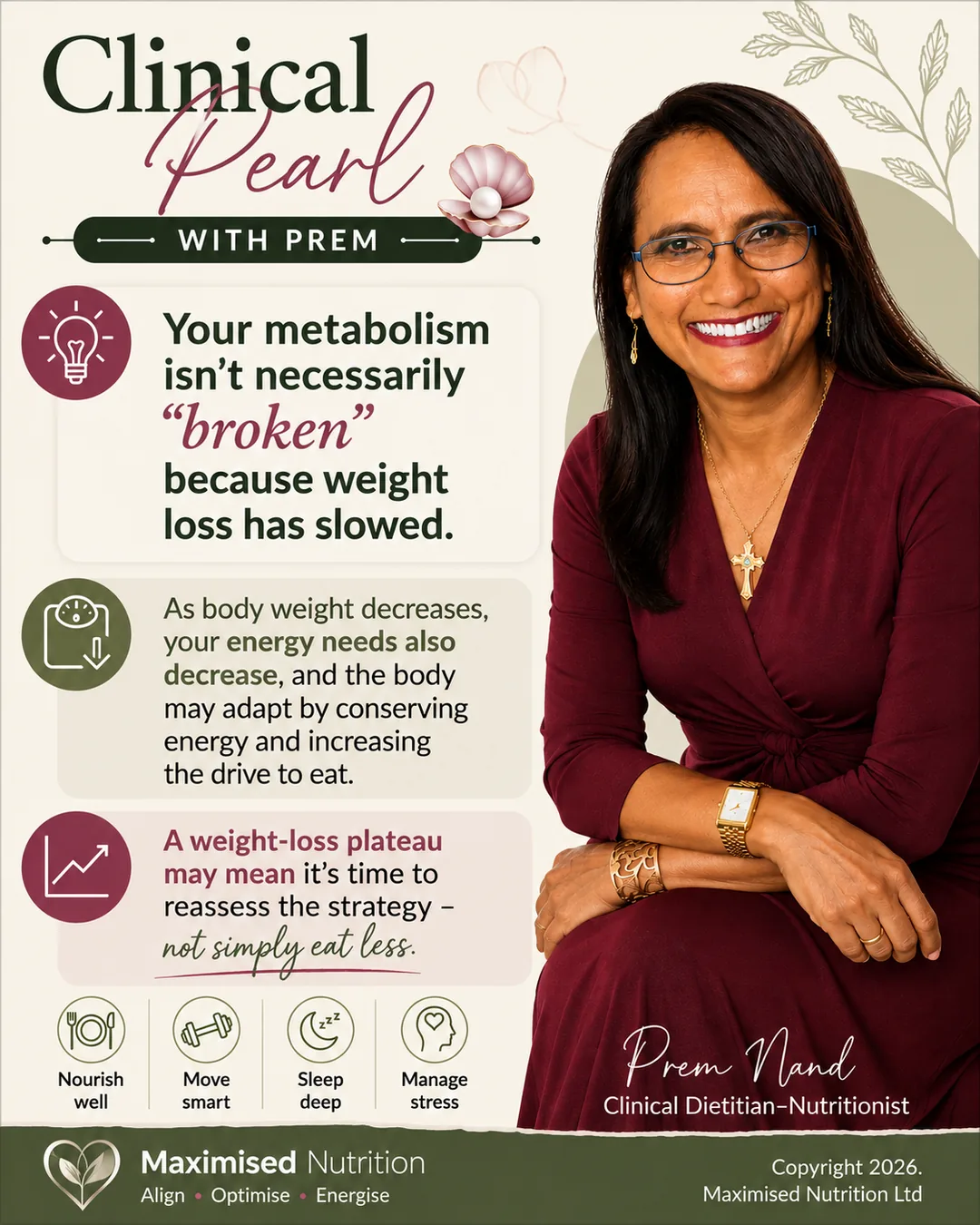
When you lose weight or substantially reduce your food intake, your body can respond by increasing hunger and reducing energy expenditure. Your smaller body also requires less energy than it did previously. Together, these changes can make continued weight loss progressively more difficult.
In other words:
Calories still matter, but your body is not a calorie calculator.
Understanding why weight loss has become difficult can therefore be more useful than simply cutting food intake again.
Weight Loss Is More Complex Than “Eat Less, Move More”
You may have been told that losing weight is simply a matter of calories in versus calories out. At a physiological level, energy balance is fundamental: body energy stores increase when energy intake chronically exceeds expenditure, and they decrease when the reverse occurs (Oussaada et al., 2019).
The problem is not the energy-balance principle itself. The problem is treating both sides of that equation as though they are completely under conscious control.
Your daily energy expenditure includes the energy required to keep you alive at rest, the energy used to digest and metabolize food, planned exercise, and the energy used during ordinary movement throughout the day. At the same time, food intake is influenced by hunger and fullness signals, food availability, reward pathways, sleep, stress, learned behaviors and your surrounding environment.
These systems communicate with one another.
When energy intake falls and weight is lost, physiological mechanisms can act to conserve energy and increase the drive to eat.
Research into the weight-reduced state shows that changes in appetite and energy expenditure can favour a return towards a previous weight (Rosenbaum 2023).
This helps explain why the same eating pattern that initially produced steady weight loss may eventually produce much slower results — or a weight-loss plateau.
What Is Metabolic Adaptation?
One factor you may hear about is metabolic adaptation, sometimes called adaptive thermogenesis.
As you lose weight, some reduction in energy requirements is expected simply because a smaller body generally requires less energy. Metabolic adaptation refers to an additional reduction in energy expenditure beyond what would be predicted from changes in body weight and body composition alone (Nunes et al., 2022).
However, this effect is often exaggerated online.
A systematic review of 33 studies involving 2,528 participants found evidence of adaptive thermogenesis in many studies, but also found considerable variation between individuals and study methods. Importantly, better-designed studies tended to find smaller or non-significant effects, and metabolic adaptation appeared to diminish after periods of weight stabilisation (Nunes et al., 2022).
So, “my metabolism is broken” is usually not an accurate explanation.
A better way to think about it is that your body can adapt to weight loss.
At the same time, the drive to eat may increase. The brain integrates signals from the gastrointestinal tract, adipose tissue and other parts of the body to regulate hunger, satiety and energy expenditure. After weight loss, changes within these systems can make maintaining the lower weight biologically more challenging (Sumithran & Proietto, 2013).
This is one reason repeated advice to simply “eat less” may eventually become both frustrating and clinically unhelpful.
The more useful question becomes:
What is influencing your energy intake, appetite, metabolism and energy expenditure — and which of those factors can realistically be changed?
That is where an individual clinical assessment can become much more informative than another restrictive diet
What Can Make Weight Loss Harder?
If your weight is not changing as expected, there may be several factors operating at the same time. These do not override energy balance, but they can influence hunger, food intake, body composition, activity and how much energy your body uses.
Can Hormones Make It Harder to Lose Weight?
Hormones help regulate appetite, glucose metabolism, fat storage and energy expenditure, so hormonal and metabolic health can influence weight management.
Insulin resistance, for example, occurs when cells become less responsive to insulin. It is commonly associated with abdominal adiposity, prediabetes, type 2 diabetes and polycystic ovary syndrome (PCOS). However, insulin resistance does not make fat loss physiologically impossible.
The more useful clinical question is whether metabolic health, appetite, eating patterns, physical activity and other factors are interacting in ways that make achieving a sustainable energy deficit more difficult.
Thyroid disease is another consideration. Hypothyroidism can contribute to modest weight gain, fatigue and reduced activity, but it should not automatically be assumed to explain significant or persistent weight gain. If symptoms suggest an underlying endocrine condition, appropriate medical assessment is preferable to simply restricting food further.
Does Menopause Make Weight Loss Harder?
Many women notice that their body changes during perimenopause and menopause, even when their eating habits have not changed dramatically.
Importantly, menopause does not simply “switch off” metabolism.
Longitudinal research from the Study of Women’s Health Across the Nation (SWAN) found that during the menopause transition, the rate of fat gain increased while lean mass declined. Interestingly, overall body weight did not accelerate in the same way, demonstrating why the number on the scales may not tell the whole story (Greendale et al., 2019).
Changes in oestrogen, ageing, sleep, activity and loss of muscle can also favour greater accumulation of abdominal or visceral fat.
For women in midlife, therefore, focusing solely on losing kilograms may miss an important part of the picture. Preserving muscle, improving metabolic health, maintaining strength and monitoring waist circumference and body composition can be just as important as body weight.
Can Poor Sleep Affect Weight Loss?
Sleep is increasingly recognised as part of weight management, although the relationship is more nuanced than simply saying that “poor sleep causes weight gain”.
A 2026 systematic review examined 30 studies involving 10,944 adults undergoing behavioural or surgical weight-loss interventions. Evidence across different aspects of sleep was mixed, but experimental studies suggested that sleep restriction may reduce fat loss. There was also some evidence that better sleep satisfaction and sleep efficiency may support weight-loss outcomes (Duan et al., 2026).
Insufficient sleep may also influence food intake, reward-driven eating, fatigue and the motivation to be physically active.
If you are trying to improve your nutrition while routinely sleeping five or six hours, addressing sleep may therefore be part of the clinical picture rather than treating it as unrelated to weight.
Could My Medication Be Affecting My Weight?
Yes. Some medications can increase appetite, alter energy expenditure or contribute to weight gain.
Examples can include certain:
• antidepressant and antipsychotic medications
• corticosteroids
• diabetes medications, including insulin
• anti-seizure medications
• hormonal treatments
The effect varies considerably between medications and between individuals.
Do not stop prescribed medication because of concerns about weight. Instead, discuss the issue with your GP or prescribing clinician. In some situations, an alternative medication with a more weight-neutral profile may be clinically appropriate.
What About Stress, Hunger and Everyday Movement?
Weight management is also affected by what happens outside planned meals and exercise sessions.
Chronic stress does not magically create body fat without an energy source, but it can influence sleep, appetite, food choices, emotional eating and physical activity. Similarly, persistent hunger can make a highly restrictive eating plan increasingly difficult to sustain.
There is also a component of energy expenditure called non-exercise activity thermogenesis (NEAT). This is the energy you use through ordinary movement that is not deliberate exercise — walking around the house, standing, doing chores, taking stairs and even fidgeting.
When someone is tired, eating substantially less or losing weight, some of this spontaneous activity can decline without them consciously noticing it.
This is why two people can follow what appears to be a similar “diet and exercise plan” yet experience quite different results.
Rather than immediately reducing calories again, it can be more useful to ask:
Am I eating in a way that supports fullness? Am I preserving muscle? Am I sleeping adequately? Has my everyday movement changed? Could medication, menopause or a medical condition be contributing?
Weight-loss difficulty is often better understood by looking at the whole physiological and behavioural picture, rather than assuming the answer is simply more restriction.
What Should I Do If I Can’t Lose Weight?
If you have been making consistent changes but your weight is not responding as expected, the answer is not necessarily to eat less.
A useful weight-management assessment looks at the whole picture: your usual food intake, hunger and fullness, protein and fibre intake, physical activity, muscle mass, sleep, stress, medications, medical history, metabolic health and previous attempts at weight loss.
Depending on your symptoms and medical history, your healthcare team may also consider whether further investigation is appropriate. This might include assessment for conditions such as thyroid dysfunction, prediabetes or type 2 diabetes, PCOS, sleep apnea or other factors affecting your health and weight.
Focus on More Than the Scales
Weight is only one measure of progress.
Depending on your circumstances, useful outcomes may also include:
• waist circumference and changes in body composition
• blood glucose, blood pressure and cholesterol
• strength and physical fitness
• improved energy and sleep
• better appetite regulation and satiety
• maintaining or increasing muscle mass
• developing an eating pattern you can realistically sustain.
For many people, a nutritionally adequate eating pattern containing sufficient protein, fibre and minimally processed foods, together with resistance and aerobic activity, can support satiety, muscle preservation and metabolic health.
The aim is not to find the lowest calorie intake you can tolerate. It is to develop an approach that improves health and can be maintained.
For some people living with obesity, medical treatment may also be appropriate. Current clinical guidelines recognise obesity pharmacotherapy, including GLP-1–based treatments, as one component of comprehensive obesity management when clinically indicated. Medication is not a substitute for nutrition care, but neither should appropriate medical treatment be viewed as a failure of willpower (Pedersen et al., 2025).
The right approach depends on your health, medications, weight-related complications, treatment goals and individual circumstances.
Frequently Asked Questions
Why am I not losing weight even though I’m eating less?
There are several possibilities. Your energy requirements may have decreased as you have lost weight, hunger may have increased, everyday movement may have fallen, or your actual energy intake may differ from what you estimate. Sleep, medications, medical conditions, menopause and changes in body composition may also contribute.
Rather than automatically cutting calories further, consider whether your current strategy is adequate, sustainable and appropriate for your health.
Can you be in a calorie deficit and not lose weight?
If a genuine energy deficit is maintained over sufficient time, stored body energy must eventually decrease. However, the scales do not measure body fat alone.
Fluid shifts, menstrual-cycle changes, glycogen, bowel contents and changes in lean tissue can temporarily mask changes in body fat. Short-term scale fluctuations therefore do not necessarily mean that no progress is occurring.
Does insulin resistance stop you from losing weight?
No. Insulin resistance does not make weight loss impossible.
However, it frequently occurs alongside metabolic conditions and excess abdominal fat and may coexist with factors that make weight management more challenging. Improving diet quality, physical activity, sleep and body composition can improve metabolic health even before large changes appear on the scales.
Can menopause cause belly fat even if my weight stays the same?
Yes, body composition and fat distribution can change during the menopause transition.
Research suggests that women may experience increasing fat mass, declining lean mass and greater central fat accumulation during midlife, even without dramatic changes in total body weight (Greendale et al., 2019). This is one reason waist circumference, strength and body composition can sometimes tell you more than body weight alone.
When should I get help with weight loss?
Consider seeking professional assessment if you are experiencing unexplained or rapid weight change, severe or persistent hunger, significant fatigue, menstrual or hormonal symptoms, symptoms suggesting sleep apnoea, difficulty managing blood glucose, or weight changes after starting medication.
It is also reasonable to ask for help simply because repeated restrictive diets are not working.
The Bottom Line
Weight loss still requires an energy deficit, but achieving and maintaining that deficit is influenced by complex biological, behavioural, medical and environmental factors.
If your weight is not changing despite your efforts, continually eating less may not be the best next step. Understanding your appetite, nutrition, metabolic health, muscle mass, sleep, activity, medications and life stage can provide a much clearer picture of what may be getting in the way.
A personalised approach can then focus not simply on making the number on the scales smaller, but on improving body composition, metabolic health, strength, energy and long-term wellbeing.
If you are struggling to understand why your weight is not responding as expected, a Clinical Dietitian–Nutritionist can help assess the contributing factors and develop a nutrition strategy appropriate for your health, lifestyle and goals.
References
Duan, L., Berryhill, J., Dai, N., Sica, G., & Chaput, J.-P. (2026). Sleep and its impact on the success of weight loss interventions in adults with excess weight: A systematic review. Obesity Reviews, e70199. https://doi.org/10.1111/obr.70199
Greendale, G. A., Sternfeld, B., Huang, M., Han, W., Karvonen-Gutierrez, C., Ruppert, K., Cauley, J. A., Finkelstein, J. S., Jiang, S.-F., & Karlamangla, A. S. (2019). Changes in body composition and weight during the menopause transition. JCI Insight, 4(5), e124865. https://doi.org/10.1172/jci.insight.124865
Nunes, C. L., Casanova, N., Francisco, R., Bosy-Westphal, A., Hopkins, M., Sardinha, L. B., & Silva, A. M. (2022). Does adaptive thermogenesis occur after weight loss in adults? A systematic review. British Journal of Nutrition, 127(3), 451–469. https://doi.org/10.1017/S0007114521001094
Oussaada, S. M., van Galen, K. A., Cooiman, M. I., Kleinendorst, L., Hazebroek, E. J., van Haelst, M. M., Ter Horst, K. W., & Serlie, M. J. (2019). The pathogenesis of obesity. Metabolism, 92, 26–36. https://doi.org/10.1016/j.metabol.2018.12.012
Pedersen, S. D., Manjoo, P., Dash, S., Jain, A., Pearce, N., & Poddar, M. (2025). Pharmacotherapy for obesity management in adults: 2025 clinical practice guideline update. CMAJ, 197, E797–E809. https://doi.org/10.1503/cmaj.250502
Rosenbaum, M. (2023). Appetite, energy expenditure, and the regulation of energy balance. Gastroenterology Clinics of North America, 52(2), 311–322. https://doi.org/10.1016/j.gtc.2023.03.004
Sumithran, P., & Proietto, J. (2013). The defence of body weight: A physiological basis for weight regain after weight loss. Clinical Science, 124(4), 231–241. https://doi.org/10.1042/CS20120223

About the Author
Prem Nand, NZRD, is an Integrative Clinical Dietitian–Nutritionist and founder of Maximised Nutrition
in New Zealand. She uses a whole-body, systems-based nutrition approach to support people with complex and medically layered health conditions, considering the interconnected role of the gut, brain, nervous system, hormones, metabolism, inflammation, and lifestyle factors in human health.

Holistic Nutrition For A Happy, Healthy, Confident You!
INFORMATION ON THIS WEBSITE IS FOR INFORMATIONAL PURPOSES ONLY.
PLEASE ALWAYS CONSULT A QUALIFIED HEALTH PRACTITIONER FOR A PERSONALISED ADVICE FOR YOUR HEALTH CONDITION
© 2025 MAXIMISED NUTRITION LTD. All Rights Reserved.