Is Chronic Inflammation Sneaking Up on You? Find out in just 60 seconds with this simple test

Can Trauma Change the Brain?
Understanding Neuroplasticity, Myelin and Healing
Author: Prem Nand, NZRD (Clinical Dietitian - Nutritionist) Published May 2026 Copyright: Maximised Nutrition Ltd
Introduction
For many years, scientists believed that the adult brain was largely fixed and unchangeable. According to this older view, the brain developed during childhood and adolescence, and thereafter remained relatively stable throughout life. However, advances in neuroscience have dramatically changed our understanding of how the brain functions.
Today, research shows that the brain remains capable of adapting, reorganising, and forming new connections throughout life. This remarkable ability is known as neuroplasticity. It helps explain how we learn new skills, recover from injuries, develop habits, and adapt to life experiences.
This raises an important question: Can trauma change the brain?
The answer is yes. Traumatic experiences can influence how the brain processes stress, emotion, safety, and threat. These processes can affect your health outcomes. However, there is also encouraging news. The same neuroplastic processes that allow trauma-related pathways to develop may also support healing, resilience, and recovery over time.
Understanding the science behind neuroplasticity, myelin, and trauma can help explain why some patterns feel difficult to change—and why meaningful recovery often requires patience, repetition, and support.
What Is Neuroplasticity?
Neuroplasticity refers to the brain's ability to change its structure and function in response to experience (Kolb & Gibb, 2015).
Every thought, behaviour, memory, emotion, and skill involves communication between billions of nerve cells called neurons. These neurons communicate through specialised connections known as synapses.
When certain neural pathways are activated repeatedly, they become stronger and more efficient. This process allows us to:
• Learn new skills
• Form memories
• Develop habits
• Adapt to new environments
• Recover from injury
A commonly cited principle in neuroscience is:
"Neurons that fire together, wire together."
This concept, based on the work of psychologist Donald Hebb, suggests that repeated activation of neural circuits strengthens the connections between them (Hebb, 1949).
Whether someone is learning to ride a bicycle, play the piano, drive a car, or speak a new language, repeated practice gradually strengthens the underlying neural pathways.
What Is Myelin and Why Does It Matter?
One of the lesser-known but fascinating aspects of neuroplasticity involves myelin.
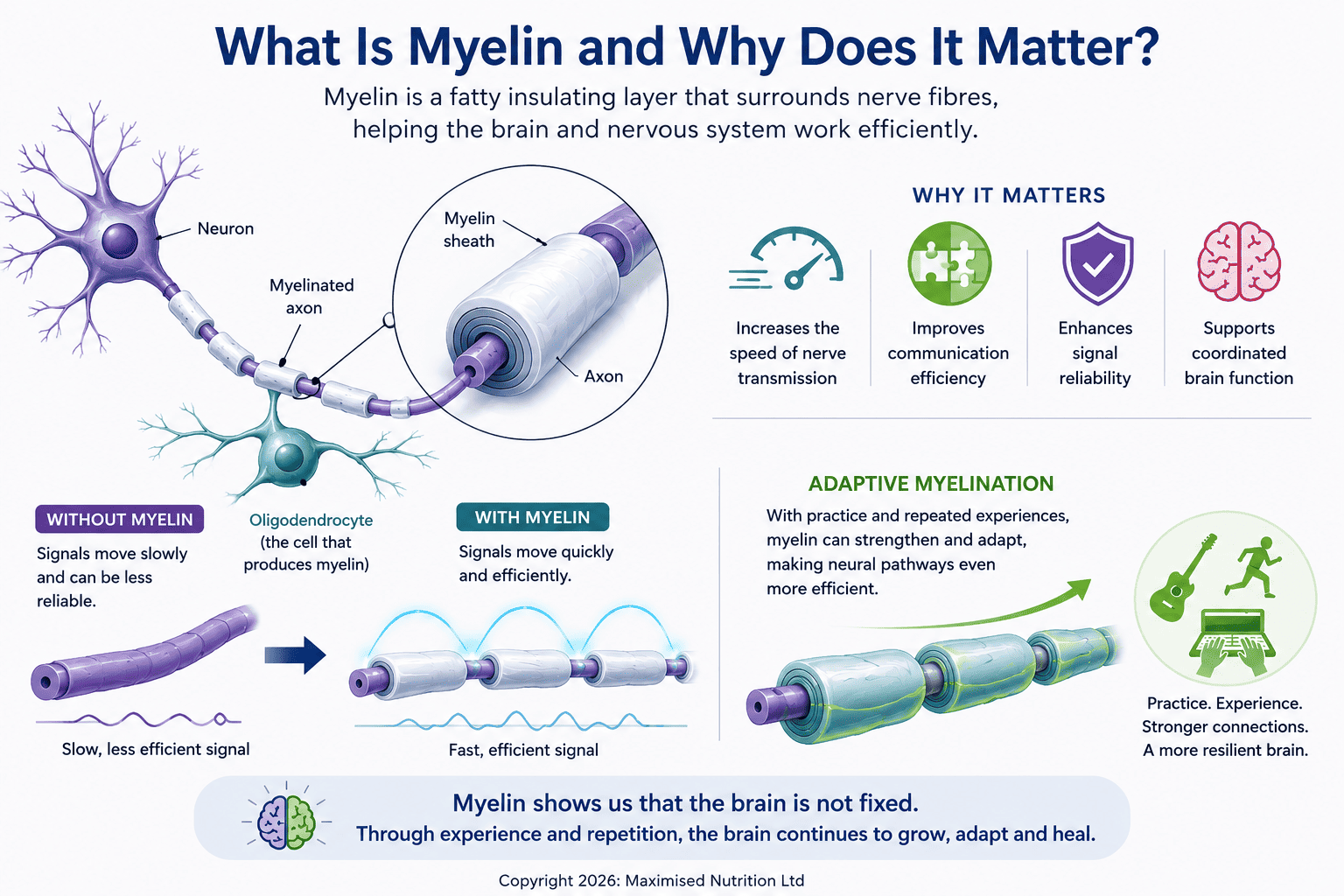
Myelin is a fatty insulating layer that surrounds many nerve fibres in the brain and nervous system. It is often compared to the insulation around electrical wiring.
Its functions include:
• Increasing the speed of nerve transmission
• Improving communication efficiency
• Enhancing signal reliability
• Supporting coordinated brain function
Myelin is produced by specialised cells called oligodendrocytes within the central nervous system.
Recent research suggests that myelin is not simply a passive structure formed during childhood. Instead, myelin can continue adapting throughout life in response to learning and experience, a process known as adaptive myelination (Fields, 2015).
For example, when a person repeatedly practises a skill such as playing the guitar, typing, or performing a sport, the neural circuits involved may become increasingly efficient. Part of this improvement appears to involve changes in myelin that help strengthen communication within those networks.
This means that repeated experiences do not merely change our thoughts—they can influence the physical architecture of the brain itself.
How Learning Changes the Brain
Consider someone learning to play the piano.
Initially, every movement requires concentration. Finger placement feels awkward, mistakes are frequent, and progress is slow.
However, after months or years of practice:
• Movements become smoother
• Speed increases
• Accuracy improves
• Less conscious effort is required
What has changed?
The answer is not simply determination or motivation. Repeated practice has strengthened neural pathways involved in motor control, timing, memory, hearing, and coordination.
Neuroscientists have demonstrated that repeated skill acquisition can lead to measurable changes within the brain's structure and connectivity (Zatorre et al., 2012).
In other words, practice physically shapes the brain.
This same principle applies not only to learning useful skills but also to emotional and behavioural responses.
Can Trauma Rewire the Brain?
Trauma can influence the brain through many of the same mechanisms involved in learning.
When an individual experiences repeated or overwhelming stress, the brain prioritises survival.
The nervous system begins learning:
• What feels dangerous
• What feels safe
• What should be avoided
• How to respond quickly to perceived threats
This process is adaptive. From an evolutionary perspective, survival depends on recognising danger and responding rapidly.
However, when traumatic experiences are severe, prolonged, or repeated, the brain may become increasingly efficient at activating survival-based responses.
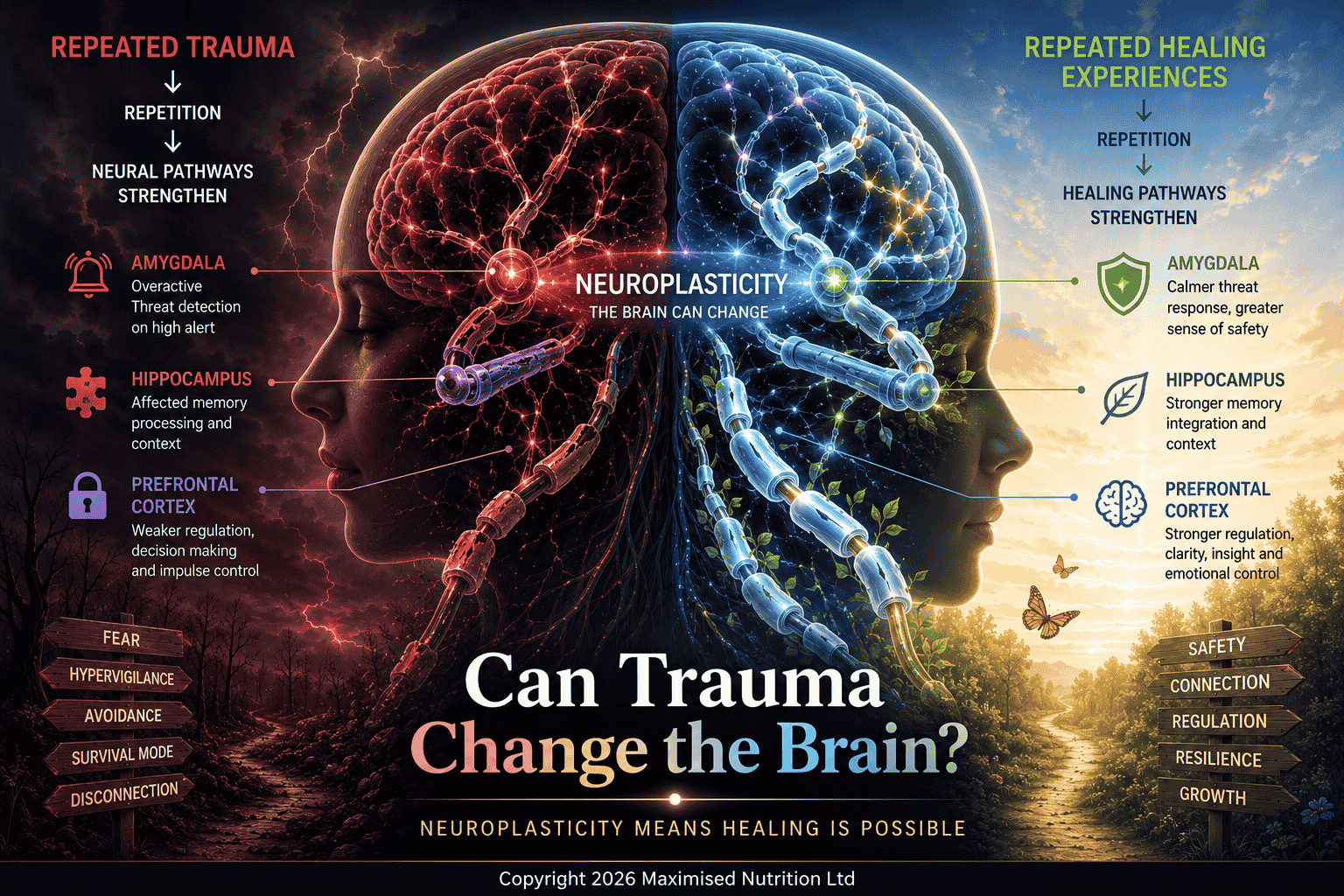
Research has shown that trauma can affect several important brain regions, including:
The Amygdala
The amygdala plays a key role in detecting threat and generating emotional responses.
Trauma exposure may lead to increased amygdala activity, resulting in heightened vigilance and stronger fear responses (Teicher et al., 2016)
The Hippocampus
The hippocampus is involved in memory formation and contextual processing.
Chronic stress and trauma have been associated with reductions in hippocampal volume in some individuals, potentially affecting memory and emotional regulation (McLaughlin et al., 2019).
The Prefrontal Cortex
The prefrontal cortex helps regulate emotions, decision-making, planning, and impulse control.
Trauma may reduce the efficiency of communication between the prefrontal cortex and emotional centres of the brain, making it harder to regulate stress responses (Arnsten, 2015).
These changes do not mean a person is permanently damaged. Rather, they reflect the brain's attempt to adapt to difficult circumstances.
Why Trauma Responses Can Feel Automatic
Many people who have experienced trauma describe reactions that seem to occur automatically.
Examples may include:
• Hypervigilance
• Anxiety
• Startle responses
• Emotional eating
• Avoidance behaviours
• Difficulty trusting others
• Persistent feelings of threat
Importantly, these responses are often not conscious choices.
Over time, repeated activation of survival pathways can make those pathways highly efficient.
An analogy often used in neuroscience is that of a well-worn walking trail.
Imagine walking the same path through a forest every day for many years. Eventually, the trail becomes wide, clear, and easy to follow.
Now imagine trying to create a new path through dense vegetation. Initially, progress is slow and difficult.
Neural pathways operate in a similar way.
Well-established pathways become easier for the brain to activate. This helps explain why insight alone does not always lead to behavioural change.
Someone may intellectually understand that they are safe, yet their nervous system may still respond as though danger is present.
The Good News: The Brain Can Continue to Change
One of the most hopeful findings in modern neuroscience is that neuroplasticity remains active throughout life.
The brain's capacity to change does not disappear after childhood.
Research suggests that new experiences, learning, relationships, behaviours, and therapeutic interventions can all contribute to the development of new neural pathways (Kolb & Gibb, 2015).
This does not mean trauma-related pathways instantly disappear.
Rather, recovery often involves strengthening alternative pathways associated with:
• Safety
• Self-regulation
• Connection
• Trust
• Resilience
• Emotional flexibility
Just as learning a musical instrument requires repetition, healing often requires repeated experiences that reinforce new patterns.
Why Healing Takes Time
Many people become frustrated when recovery does not happen quickly.
However, neuroscience provides an explanation.
The brain changes through repetition.
If survival-based pathways have been reinforced over many years, it is unrealistic to expect them to disappear overnight.
Instead, healing often involves gradually creating stronger alternative pathways through consistent experiences of safety and regulation.
This helps explain why interventions such as counselling, trauma-informed therapy, mindfulness, exercise, and supportive relationships may require ongoing practice before meaningful changes become apparent.
Neural rewiring is rarely a single event. More often, it is a process.
The Role of Nutrition in Brain Health and Neuroplasticity
While nutrition cannot erase trauma, it can help create an environment that supports brain health and recovery.
The brain is metabolically active and requires a steady supply of nutrients to function optimally.
Several nutritional factors have been linked to healthy brain function and neuroplasticity.
Adequate Protein
Protein provides amino acids that serve as building blocks for neurotransmitters involved in mood, attention, and emotional regulation.
Omega-3 Fatty Acids
Omega-3 fats, particularly DHA, are important structural components of brain cell membranes and may support neuroplasticity and cognitive function (Bazinet & Layé, 2014).
Magnesium
Magnesium plays a role in neurotransmission and nervous system regulation. Inadequate intake may contribute to heightened stress sensitivity in some individuals.
Blood Sugar Stability
Large fluctuations in blood glucose can affect mood, energy, concentration, and stress tolerance.
Balanced meals that include protein, healthy fats, and fibre may help support more stable energy levels throughout the day.
Gut-Brain Communication
Emerging research highlights the complex relationship between the gut microbiome and the brain.
Although this field continues to evolve, gut health may influence mood, stress responses, and overall wellbeing through multiple pathways within the gut-brain axis (Cryan et al., 2019).
Practical Ways to Support Neuroplasticity
While every individual's recovery journey is unique, several evidence-based strategies may support healthy brain adaptation.
These include:
• Prioritising restorative sleep
• Engaging in regular physical activity
• Practising mindfulness or meditation
• Building supportive relationships
• Seeking trauma-informed professional support
• Maintaining balanced nutrition
• Learning new skills and hobbies
• Spending time in meaningful activities
• Developing consistent daily routines
Importantly, small actions repeated consistently often have a greater long-term impact than occasional large efforts.
A Message of Hope
The science of neuroplasticity offers an encouraging perspective on trauma and recovery.
Trauma can influence the brain. It can shape neural pathways, stress responses, emotional processing, and behaviour. Yet trauma is not the final chapter of the story.
The same brain that learned fear can also learn safety.
The same nervous system that adapted to survive difficult experiences can continue adapting toward healing.
Recovery is often not about erasing the past. Rather, it involves creating new experiences, relationships, habits, and patterns that gradually strengthen healthier neural pathways.
Neuroscience increasingly supports what many clinicians, counsellors, and individuals in recovery have long observed: meaningful change is possible.
The brain remains capable of growth throughout life.
And with time, support, nourishment, and repeated experiences of safety, healing can occur.
References
Arnsten, A. F. T. (2015). Stress weakens prefrontal networks: Molecular insults to higher cognition. Nature Neuroscience, 18(10), 1376–1385. https://doi.org/10.1038/nn.4087
Bazinet, R. P., & Layé, S. (2014). Polyunsaturated fatty acids and their metabolites in brain function and disease. Nature Reviews Neuroscience, 15(12), 771–785. https://doi.org/10.1038/nrn3820
Cryan, J. F., O'Riordan, K. J., Cowan, C. S. M., Sandhu, K. V., Bastiaanssen, T. F. S., Boehme, M., ... Dinan, T. G. (2019). The microbiota-gut-brain axis. Physiological Reviews, 99(4), 1877–2013. https://doi.org/10.1152/physrev.00018.2018
Fields, R. D. (2015). A new mechanism of nervous system plasticity: Activity-dependent myelination. Nature Reviews Neuroscience, 16(12), 756–767. https://doi.org/10.1038/nrn4023
Hebb, D. O. (1949). The organization of behavior: A neuropsychological theory. Wiley.
Kolb, B., & Gibb, R. (2015). Plasticity in the developing brain and its relation to rehabilitation. Frontiers in Human Neuroscience, 9, 541. https://doi.org/10.3389/fnhum.2015.00541
McLaughlin, K. A., Weissman, D., & Bitrán, D. (2019). Childhood adversity and neural development: A systematic review. Annual Review of Developmental Psychology, 1, 277–312. https://doi.org/10.1146/annurev-devpsych-121318-084950
Teicher, M. H., Samson, J. A., Anderson, C. M., & Ohashi, K. (2016). The effects of childhood maltreatment on brain structure, function and connectivity. Nature Reviews Neuroscience, 17(10), 652–666. https://doi.org/10.1038/nrn.2016.111
Zatorre, R. J., Fields, R. D., & Johansen-Berg, H. (2012). Plasticity in gray and white: Neuroimaging changes in brain structure during learning. Nature Neuroscience, 15(4), 528–536. https://doi.org/10.1038/nn.3045

About the Author
Prem Nand, NZRD, is an Integrative Clinical Dietitian–Nutritionist and founder of Maximised Nutrition
in New Zealand. She uses a whole-body, systems-based nutrition approach to support people with complex and medically layered health conditions, considering the interconnected role of the gut, brain, nervous system, hormones, metabolism, inflammation, and lifestyle factors in human health.

Holistic Nutrition For A Happy, Healthy, Confident You!
INFORMATION ON THIS WEBSITE IS FOR INFORMATIONAL PURPOSES ONLY.
PLEASE ALWAYS CONSULT A QUALIFIED HEALTH PRACTITIONER FOR A PERSONALISED ADVICE FOR YOUR HEALTH CONDITION
© 2025 MAXIMISED NUTRITION LTD. All Rights Reserved.